

Your bedroom and bathroom don’t need to be twins—they need to *flow*. I used to think matching meant identical, which felt suffocating. Instead, I’ve learned that a shared neutral wall color, complementary textures (linen, wood, brushed brass), and a consistent two-to-three color palette create invisible threads connecting spaces without screaming “we’re coordinated!”
Your bathroom can whisper coastal vibes while your bedroom expresses them fully—same undertones, different personality. It’s connection without the sterile showroom effect, and there’s actually a smarter way to pull it off.
Do Your Bedroom and Bathroom Really Need to Match?
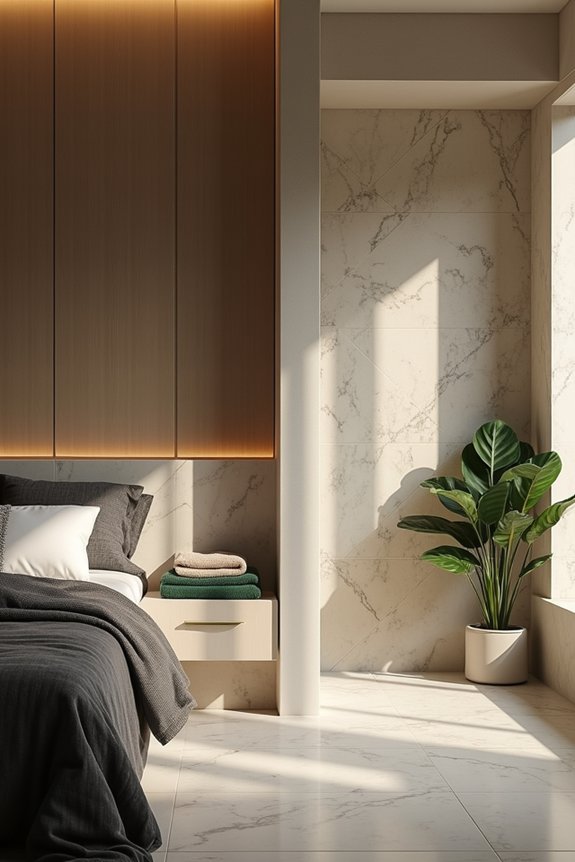
Why do we torture ourselves with the matching game? Honestly, your bedroom and bathroom don’t need to be twins separated at birth. What matters is cohesion—that feeling of belonging to a unified sanctuary, not identical showroom vibes.
Your bedroom and bathroom don’t need to be twins—cohesion matters more than matching.
I used to stress over matching everything until I realized a neutral wall color and complementary textiles do the heavy lifting. You’re not decorating for Pinterest; you’re creating spaces that work well together.
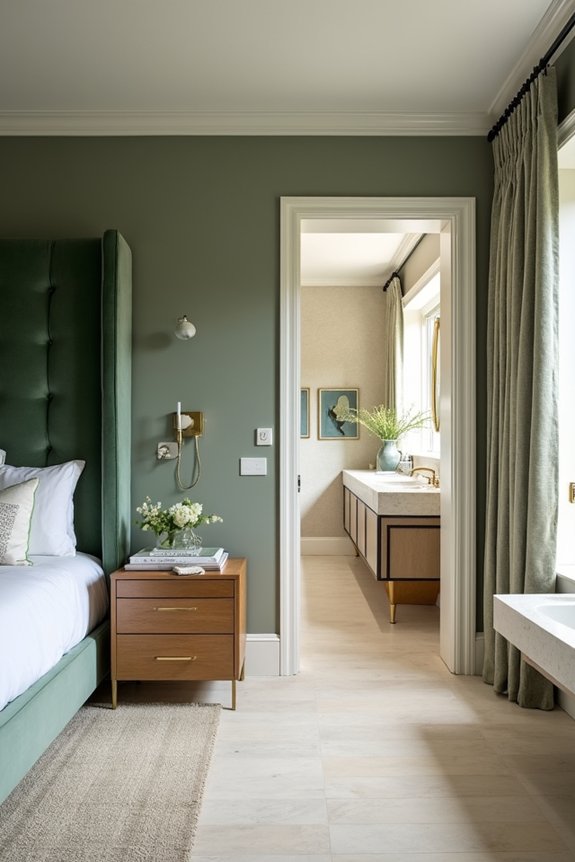
Think of it this way: a consistent color palette of two or three main colors, plus coordinated lighting and hardware, creates continuity without cookie-cutter sameness. Share undertones, balance contrast, and suddenly your emerald bedroom flows naturally into a white marble bath with gold accents.
That’s the approach—harmony beats uniformity every single time.
Creating Cohesion Beyond Matching: Textures, Hardware, and Accents
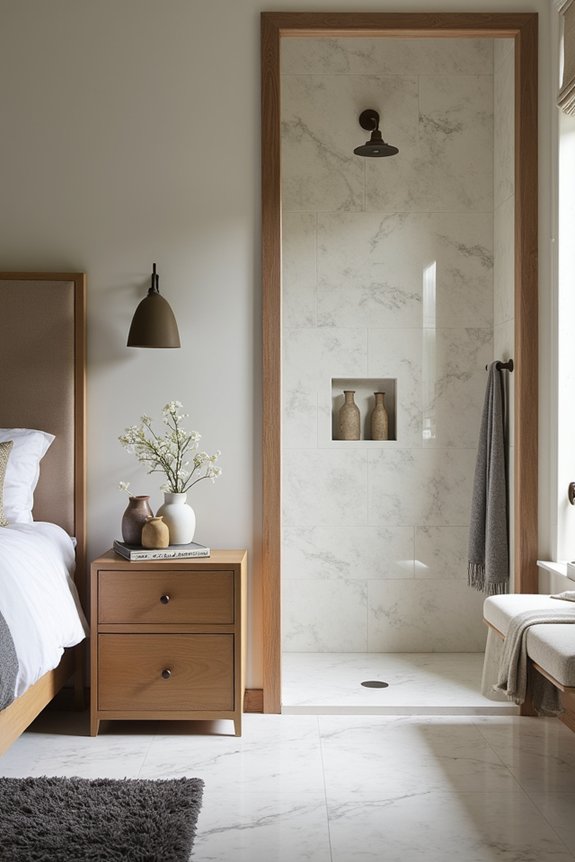
Now that you’ve ditched the tyranny of matching twins, here’s where the real substance happens—and I’m talking about the stuff that actually makes your spaces feel connected.
I discovered this accidentally while staring at my mismatched nightstands, wondering if I’d failed at adulting. Turns out, cohesion doesn’t require identical furniture. Instead, I layered textures—linen, wood, brushed brass hardware—across both rooms, creating an invisible thread connecting them.
| Element | Bedroom | Bathroom |
|---|---|---|
| Hardware Finish | Brushed brass knobs | Brushed brass towel bars |
| Texture | Linen bedding | Linen hand towels |
| Color Undertone | Warm neutral base | Warm neutral base |
| Accents | Coastal artwork | Coastal ceramic soap dish |
This approach? It whispers rather than shouts. Your spaces communicate design decisions without announcing “we match!”—which is far more sophisticated than my ketchup-stained throw pillow deserved.
Paint Colors That Connect Bedroom and Bath
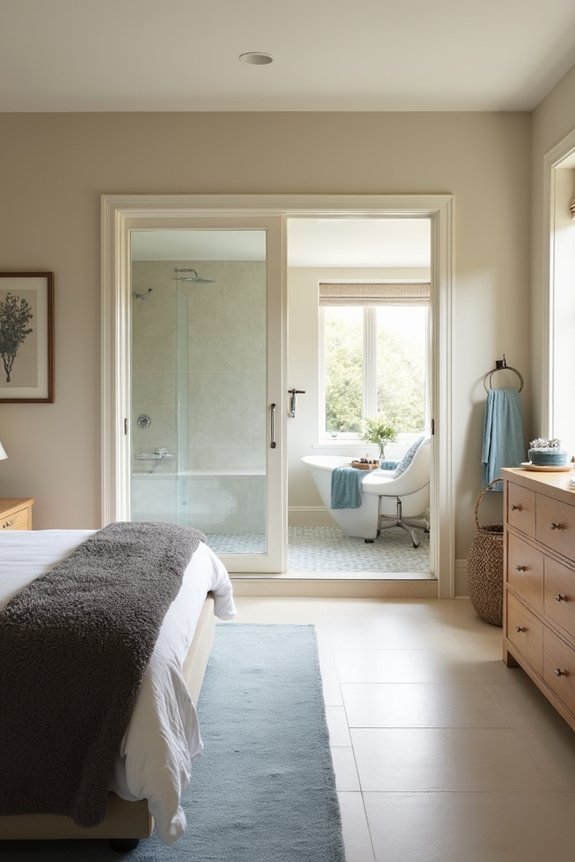
If you’ve ever stood in the paint aisle holding two chips that looked identical under fluorescent lights, then watched them shift into “eggshell” and “dinosaur egg” on your actual walls, you understand: paint color is where cohesion either happens or falls apart.
I’ve learned that a shared neutral wall color creates visual continuity without demanding matchy-matchy perfection. Instead of duplicating everything, I introduce personality through textiles—bedding and towels—that echo each space’s character. Analogous colors work well here, connecting rooms with soft, natural flow. I’m currently exploring a calm blue palette: lighter bathroom hues paired with deeper bedroom tones that preserve tranquility.
Two to three main colors maintain cohesion effectively. This approach—anchored by neutral walls, unified through strategic color—lets each room have its own identity while keeping everything intentionally connected.
Six Design Styles for a Unified Master Suite
| Design Style | Bedroom Approach | Bathroom Approach |
|---|---|---|
| Modern Minimalist | Clean lines, neutral palette | Sleek fixtures, frameless glass |
| Coastal Retreat | Natural wood, soft blues | Weathered finishes, sea tones |
| Industrial Chic | Metal accents, concrete textures | Exposed pipes, raw materials |
When you maintain this unity through consistent finishes and intentional continuity, your master suite stops feeling like two separate rooms and becomes a cohesive space—a sanctuary where design decisions work together to create an environment you actually want to spend time in.
Personalizing Each Room While Maintaining Flow
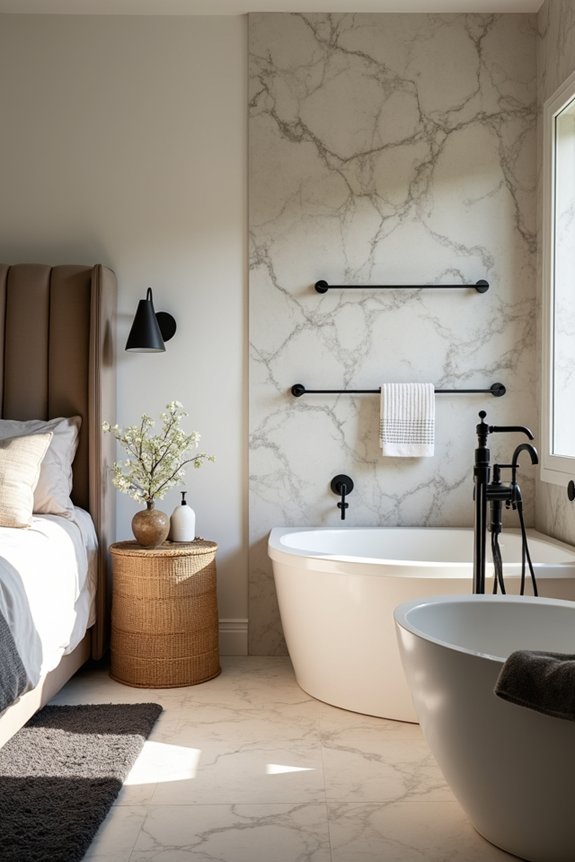
Here’s the thing about matching your bedroom and bathroom—you don’t actually have to turn them into design twins, and honestly, I’m relieved about that because my bathroom currently houses a Chuck E. Cheese cup collection that’d horrify any designer.
Instead, you can personalize each room while maintaining cohesion through strategic choices. I’m using a shared neutral wall color across both spaces, then introducing color through textiles—bedding in soft blues, towels in deeper navy. Different shades of that same color create flow without feeling matchy-matchy. I’ve repeated my hardware finishes and lighting style, which ties everything together.
The bathroom’s become its own retreat with complementary accents echoing my bedroom’s mood. Distinct yet harmonious—exactly what belonging feels like.