Small spaces feel cozy because they literally trick your nervous system into relaxing—fewer sightlines mean less threat-detection, so your brain can actually chill. I’ve crammed myself into studios where warm lighting, natural textures, and intentional arrangement made me feel safer than sprawling apartments ever did. Proximity forces genuine connection instead of awkward distance.
It’s counterintuitive: constraint becomes comfort when you layer in the right materials, anchor visual focal points, and reduce visual clutter. There’s more to understand about why your tiny room beats that McMansion vibe.
The Psychology of Enclosure and Safety
Here’s the catch about small spaces—they’re basically the architectural equivalent of a security blanket, except you can’t accidentally leave them at the airport. When you’re nestled in a compact room, your brain actually relaxes. Smaller, well-defined spaces reduce visual chaos and create genuine enclosure and security that larger rooms simply can’t match. I used to think I wanted sprawling openness, then I realized I was just envious—turns out my brain preferred containment. That bounded feeling? It’s not claustrophobia; it’s your nervous system saying, “I can monitor this.” Natural textures, warm lighting, and carefully chosen objects strengthen this sense of safety, turning a modest bedroom into your personal fortress. You’re not cramped. You’re protected.
How Smaller Rooms Pull You Closer
I’ve noticed that whenever my family actually gathers in our cramped living room—forget the sprawling basement nobody uses—we’re naturally forced into proximity, which designers call “intentional compression,” though I call it “my mom’s ketchup-stained couch strategy.” Small rooms don’t give you the option to scatter like we do in bigger spaces; instead, they orchestrate a kind of physical intimacy where everyone stays within conversational distance, and honestly, that accidental togetherness might be what makes these spaces feel warm rather than isolating. The real value emerges when every inch serves a purpose—built-ins, multipurpose furniture, minimal hallways—because suddenly there’s nowhere to hide, and paradoxically, that constraint shapes a room into something that feels protective rather than claustrophobic, like my parents’ inexplicable insistence that cramming us all into a 200-square-foot cottage was “character-building” when it was really just clever spatial psychology.
Proximity Fosters Intimate Connection
Why does my mom insist on hosting twelve people in her living room when she’s got a perfectly good dining room gathering dust? Turns out, she’s onto something. Small spaces physically pull you closer—literally. When I’m wedged between my cousin and someone’s Chuck E. Cheese cup, conversation happens whether I like it or not. That proximity isn’t annoying; it’s intimate. Designers call it “enhanced connection,” but I call it “can’t escape Aunt Susan’s story about her sourdough starter.” Here’s the thing: reduced distance eliminates social hiding spots. You’re forced to engage. No drifting to separate rooms, no pretending you didn’t hear someone. In small spaces, you belong—whether you planned to or not. My mom knew this all along.
Intentional Design Maximizes Purpose
You know what my mom does that drives me absolutely nuts? She insists on displaying every commemorative spoon, dusty figurine, and Chuck E. Cheese cup she’s ever owned. Meanwhile, I’m over here trying to create a cozy space that doesn’t feel like a thrift store exploded.
Here’s the thing—design choices actually matter. When you minimize clutter and choose what stays purposefully, you’re not just tidying; you’re creating breathing room. A single shelf for collections, muted color palettes, strategic focal points like fireplaces—these aren’t design rules my mom follows, but they work in small spaces to make them feel more intimate.
The genius? Every element serves double duty. Staircases divide rooms. Open layouts merge spaces. Nothing says “I belong here” quite like a room where everything has a reason and nothing’s fighting for attention.
Enclosure Creates Psychological Warmth
That’s the mechanism at work. Tight quarters create psychological cocoons—your eye doesn’t scatter across endless emptiness. Instead, you settle. Designers call this “perceived intimacy.” Your brain stops running threat-detection software and actually exhales. Smaller rooms *hold* you, making belonging feel less theoretical and more like something you’re literally wrapped inside.
Warmth Through Natural Materials and Textures
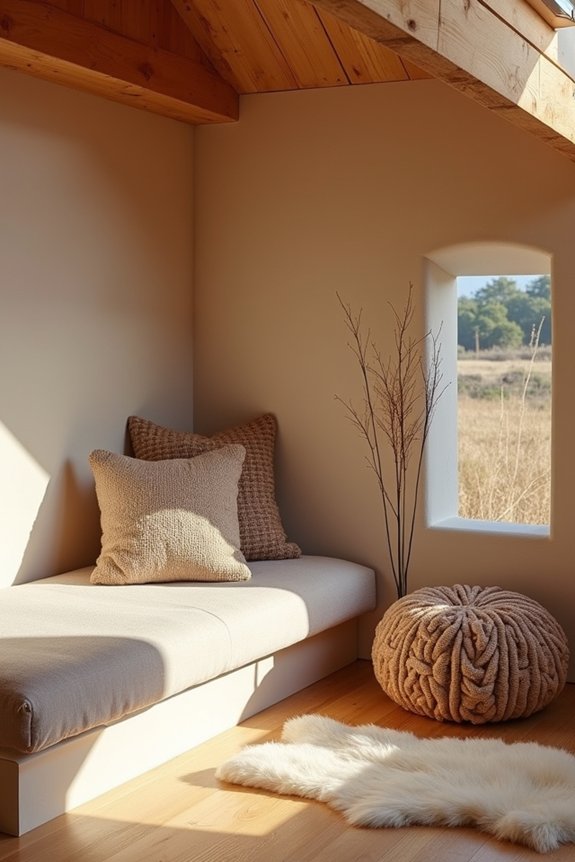
Natural materials don’t just look cozier—they *feel* like they’re actually warming you up, which is either genius design or a placebo so powerful it should be bottled and sold. I layered a raw wood coffee table with ceramics, aged wood, and soft throws—suddenly my space had direction and purpose. When I swapped metal shelving for weathered brick accents, the whole vibe shifted. Textures matter. A wool rug, linen pillows, cotton throws—they’re tactile variety without eating square footage. Even dried flowers and pinecones scattered around add organic warmth. My parents always said “simplicity works,” yet somehow their living rooms felt sterile. Mine? Mine finally feels like somewhere I belong.
Which Colors Wrap You in Comfort
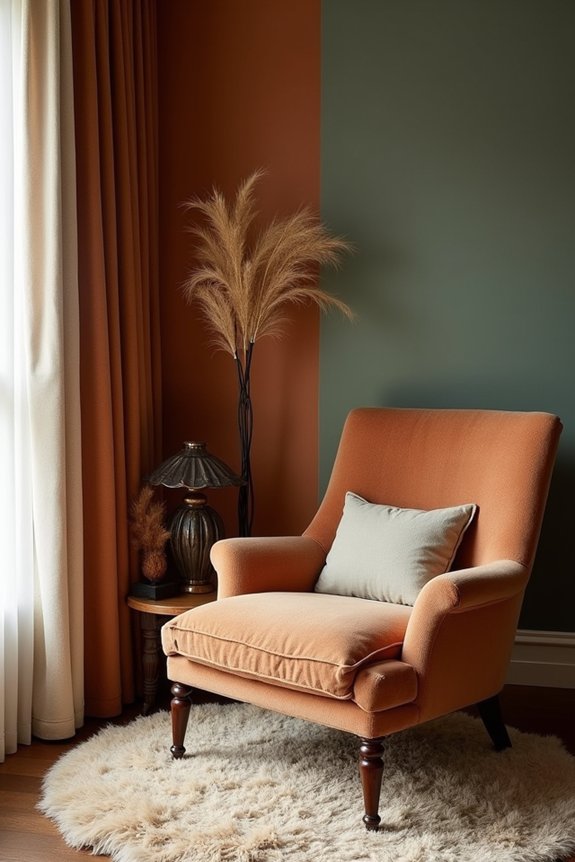
I’ve learned the hard way that slapping bold jewel tones on my cramped living room walls—thanks, Pinterest—just made it feel like I’d trapped myself in an expensive shoebox, so now I’m all-in on warm earth tones and soft muted palettes that actually don’t make me want to scream. There’s something almost magical about how a terracotta accent wall or dusty sage paired with cream actually expands the room in my brain, even though square footage hasn’t changed one inch; it’s pure color psychology doing the heavy lifting. My designer friend calls it “tonal harmony,” but I call it finally understanding why my parents’ beige-on-taupe approach from 1997 didn’t make me claustrophobic—turns out they accidentally nailed comfort without meaning to.
Warm Earth Tones
Color’s where the real magic happens in a cramped room—and I don’t mean that in a mystical, chakra-balancing way, but in a practical sense that even my color-blind dad can appreciate. Warm earth tones create the coziness I’ve been chasing since my dorm days, wrapping small spaces in safety without requiring renovations I can’t afford.
Here’s what actually works:
- Earthy browns and muted terracottas generate feelings of grounding that reduce anxiety
- Natural-inspired palettes prevent visual chaos, making rooms feel less claustrophobic
- Deeper accents like charcoal brown add depth without overwhelming cramped areas
Pair these tones with soft textures—wool, linen, cotton—and suddenly my shoebox apartment doesn’t feel like one. The combination signals my brain that I’m protected, enclosed, belonging somewhere. That’s not decoration; that’s survival.
Soft Muted Palettes
So here’s where I learned the difference between “small” and “suffocating”: it’s not the square footage—it’s the color screaming at you from every wall. I painted my studio apartment seafoam green once. Mistake. Now I stick with monochromatic palettes instead—soft, muted tones that let your eye rest rather than bounce around like a caffeinated toddler.
When I switched to warm neutrals and creams, something shifted. The chaos quieted. Suddenly, my shoebox bedroom didn’t feel like a Chuck E. Cheese cup somebody abandoned—it felt deliberate, considered. Monochromatic color schemes do that; they reduce visual clutter and give spaces room to breathe. Paired with natural materials, these soft hues signal safety to your brain, wrapping you in genuine comfort rather than screaming for attention like my former ketchup-red accent wall.
Lighting Strategy: Soft Layering Over Harsh Brightness
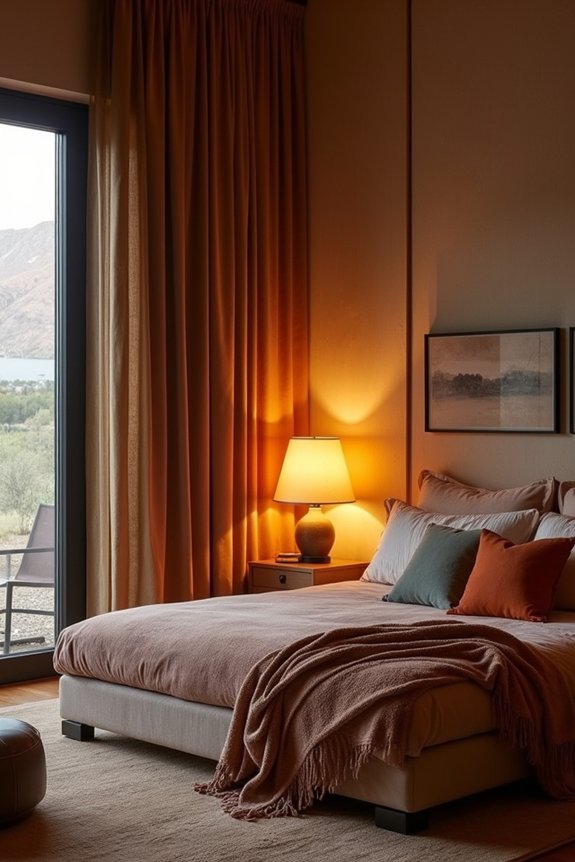
I learned this the hard way. My overhead fixture screamed institutional cafeteria; my friend’s layered approach whispered *come sit with me*. Here’s what works:
- Warm-toned bulbs replace harsh white lights, creating natural comfort instead of interrogation-room vibes
- Multiple sources—lamps, sconces, candles—build depth and intimate zones without flattening everything into one exhausted room
- Texture highlighting through subtle shadows makes wood grain and textiles feel tactile, wrapping you in warmth
Soft layering doesn’t just brighten small spaces; it makes them into places where you actually want to exist.
Smart Storage Hides Clutter, Shows Personality
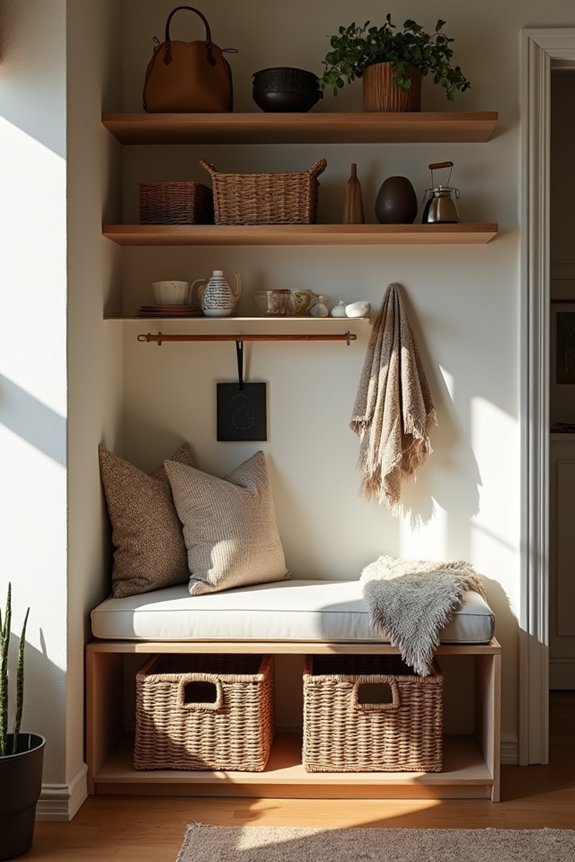
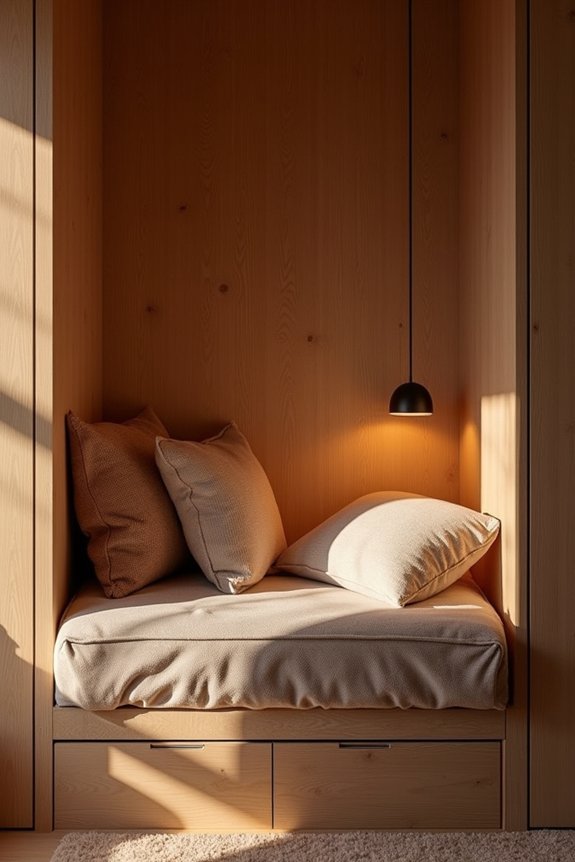
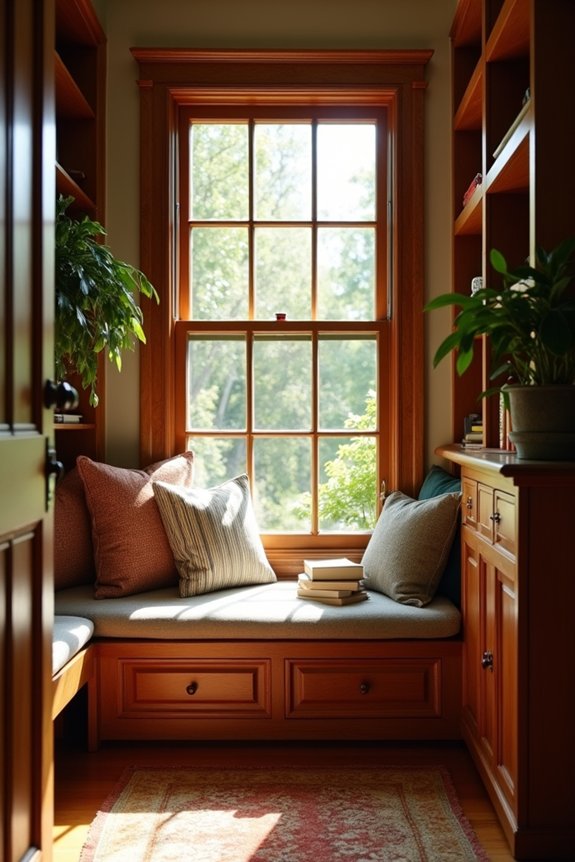
Built-in shelving, banquettes, and daybeds don’t just maximize function; they create designated homes for our stuff, bringing order to chaos and displaying what matters to us. That gallery wall? It shows who you are without consuming your floor space. A kitchen banquette? It stores clutter while inviting lingering.
Here’s what built-ins truly accomplish: they organize our belongings effectively, creating visual calm. You’re not hiding who you are—you’re just keeping the ketchup-stained napkins out of sight. The result? A space that feels organized and thoughtful, more like home than a storage unit.
Focal Points That Draw the Eye and Settle the Mind
Why does staring at a blank wall make you feel like you’re trapped in a shoebox, yet one well-placed fireplace—or even a dramatically lit bookshelf—suddenly makes that same room feel purposeful? I’ve discovered that a focal point isn’t just décor; it’s psychological support.
A focal point isn’t just décor—it’s psychological support that transforms a cramped space from suffocating into deliberately intimate.
Here’s what makes cramped spaces feel welcoming:
- Draws your eye forward, making rooms feel deeper than they actually are
- Anchors attention, so your brain stops cataloging every stray Chuck E. Cheese cup
- Creates calm, giving your mind somewhere to rest instead of bouncing anxiously off walls
A dominant artwork or architectural detail does something powerful—it tells your brain the space has purpose. That visual anchor settles the nervous system, turning claustrophobia into deliberate intimacy. Suddenly, small doesn’t mean suffocating.
How Scent, Sound, and Touch Make Small Spaces Cozy
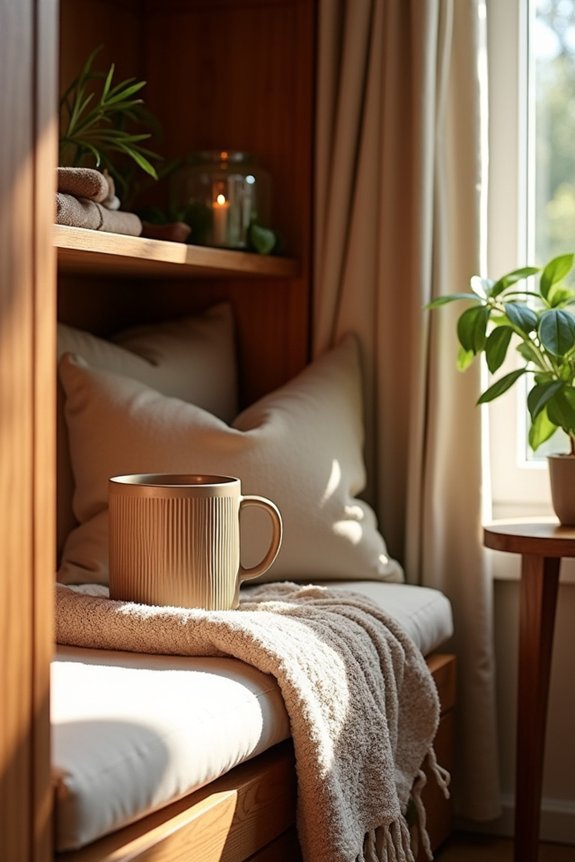
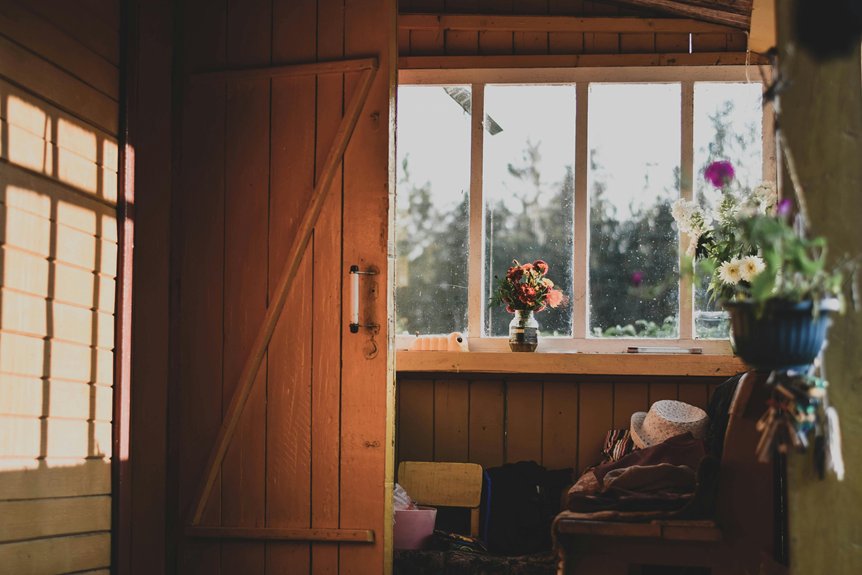
I’ve spent years chasing my parents’ cabin aesthetic—you know, the one where pine-scented candles and wind chimes somehow erase the memory of my kid spilling ketchup on the throw blanket—and I finally get it: our senses crave enclosure, and when a small space smells like forest, sounds like gentle rustling (not cartoon violence from the next room), and feels like wool under your fingertips, your nervous system settles into comfort. Natural elements ground us in a way that screaming at Chuck E. Cheese cups never will, which explains why interior designers keep talking about texture and scent creating intimate spaces—they’re not wrong, they’re just being diplomatic about the fact that we’re all basically trying to build sensory cocoons to escape our chaotic lives.
Sensory Enclosure And Intimacy
- Pine-scented candles that whisper “forest cabin” instead of “air freshener aisle”
- Soft wool throws and linen curtains that muffle external chaos
- Warm amber lighting from multiple sources creating cocoon-like privacy
Designer Peter Zec notes that intimate spaces require “multisensory grounding.” Touch matters enormously—natural materials against skin signal safety. Sound matters too; wind chimes or soft ambient noise drown out neighbors’ arguing or their inexplicable 2 a.m. vacuum sessions. Scent? It’s memory’s shortcut. These elements don’t just decorate; they envelop you, making cramped spaces feel genuinely intimate rather than confined.
Natural Elements Foster Grounding
How’s this for a parental contradiction: my mom stuffs our tiny cabin with scented candles and soft blankets—the whole sensory spa treatment—then complains that I’m “too comfortable” and need to go outside. But here’s what she doesn’t realize: that pine scent, the wool throw, the wind rustling through aspens? They’re not making me lazy. They’re grounding me. The tactile warmth of linen, the ambient sounds of nature—these sensory cues work together, anchoring me to something real. Meanwhile, a chipmunk darts past the window, and I’m simultaneously cozy and aware. That’s what small spaces offer: natural elements create sanctuary without isolation. I get it now. Mom’s not contradicting herself. She’s just frustrated that her sensory setup actually works.
Why Confined Spaces Slow You Down
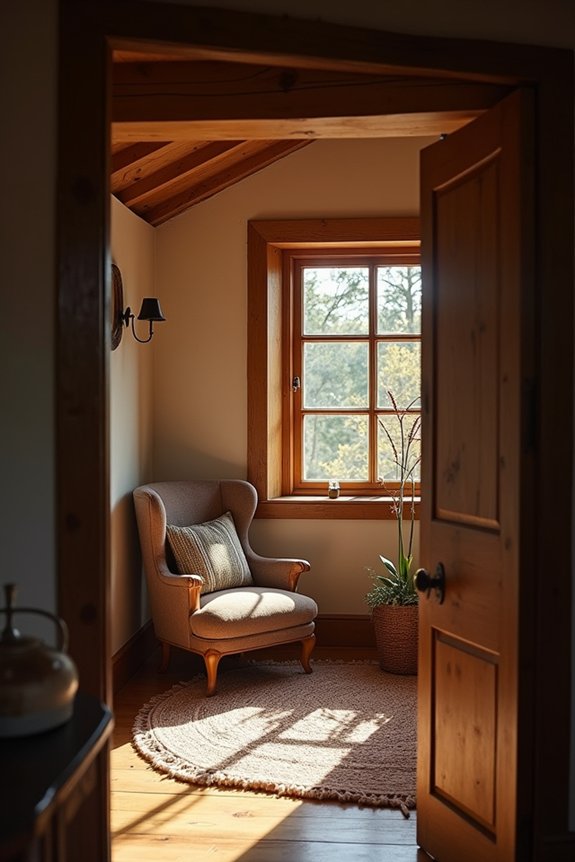
Ever notice how you can’t quite sprint through your grandmother’s living room the way you bolt through a parking garage?
That’s what confined spaces do—they inherently pace us. When you’re nestled in a cozy nook, your brain downshifts. Instead of scanning endless options, you’re forced into deliberate choices:
- Limited sightlines reduce decision fatigue
- Fewer pathways encourage thoughtful movement
- Reduced visual chaos slows mental processing
A designer once told me that small spaces “anchor attention like an invisible hand on your shoulder.” Mine just gets sticky from spilled ketchup, but the principle holds. Your body can’t help but match the intimate scale—you’re not rushing anywhere when there’s nowhere to rush. You settle in, literally and psychologically, because the space won’t let you do anything else.
Room Size That Feels Just Right
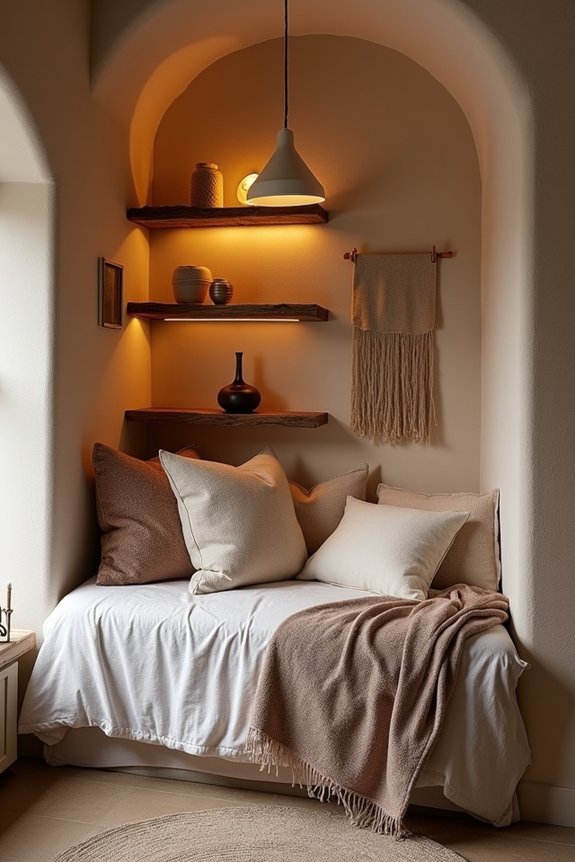
So your brain’s downshifted, your body’s settled—but here’s the catch: you can’t just stuff a king-size bed, a sectional, and your entire Chuck E. Cheese collection into a small space without it feeling like a storage unit’s having an identity crisis.
The trick? Finding that Goldilocks zone where everything serves double duty.
| Design Element | Function | Coziness Factor |
|---|---|---|
| Built-in benches | Seating + storage | High |
| Focal point windows | Visual expansion | High |
| Open floor plan | Flow + perceived size | Medium |
You’re not cramming more stuff in—you’re being deliberate. A point of visual interest at room’s end guides your eye outward, tricking your brain into feeling spacious. Layered lighting, muted colors, multi-purpose furniture—these aren’t design choices. They’re survival strategies. Your small space becomes livable, not just survivable.
Your Treasures Make a Small Space Feel Like Home
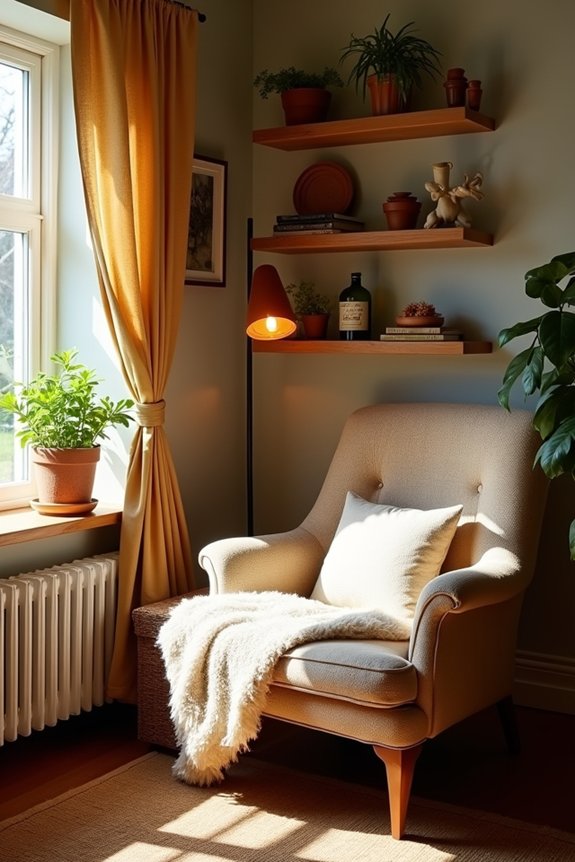
Why does your mom’s vintage vase—the one she’s warned you about since 1987—suddenly matter more when you’re staring at 400 square feet? In small spaces, your personal treasures aren’t just decoration; they’re anchors. They’re proof you’ve lived, loved, and survived at least one Chuck E. Cheese birthday party without permanent ketchup stains.
Your treasures fill cramped quarters with meaning:
- Gallery walls with gilt frames and postcards create focal interest without expanding your footprint
- Framed keepsakes—grandma’s locket, that faded postcard from somewhere you almost visited—personalize the room instantly
- Mixed textures from heirloom objects to rustic finds layer depth, making walls feel purposeful rather than desperate
That vintage vase? Finally justified. Small spaces work when they’re filled with objects that whisper your story back to you, making every corner feel earned, lived-in, and unmistakably home.
How Small Rooms Lower Stress
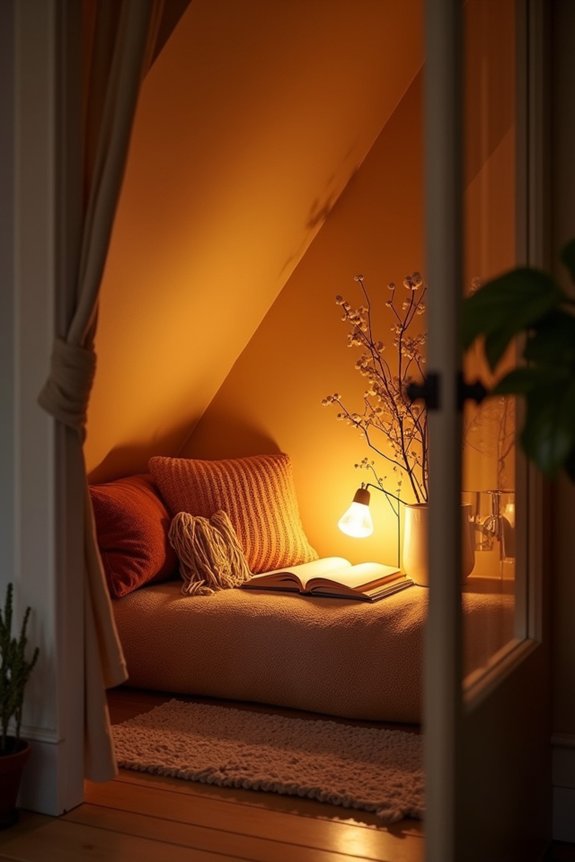
Last month, I spent three weeks in a cabin smaller than my parents’ walk-in closet—you know, the one they warned me never to touch—and my cortisol levels have never been happier. The pine scent, the wind through trees, that contained feeling: my anxiety actually floated away on the breeze. Small rooms work like stress-reducing spaces. Limited external stimuli mean your brain isn’t constantly processing chaos—no competing visual noise, no sensory overload demanding attention. Intimate spaces promote reflection without distraction. With deliberate design choices—warm materials, layered lighting, focal points—you’re building a sanctuary that lowers perceived busyness. It’s not magic. It’s just your nervous system finally getting permission to breathe.