
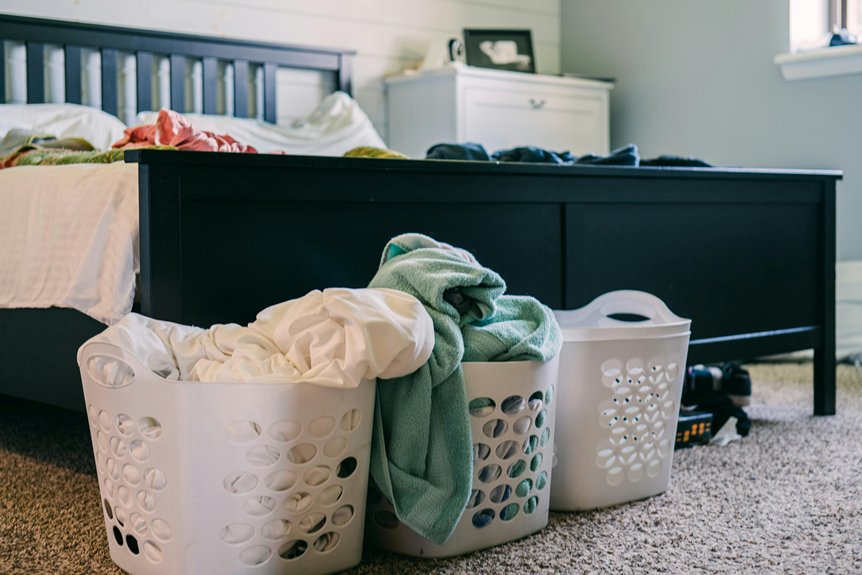
I’ve learned the hard way—after cramming my bedroom like a Chuck E. Cheese storage unit—that restraint beats abundance every single time.
Start with warm neutrals (creams, soft beiges), then add one accent color max.
Use storage beds, compact dressers with hidden drawers, and position furniture against walls to keep your floor open.
Plants whisper, don’t shout.
Mirrors bounce light.
Skip the clutter; embrace strategic emptiness.
Your nervous system’ll thank you.
Want the specific moves that actually work?
Start With a Light, Cohesive Color Palette
How’d I end up with a bedroom that looked like a paint store exploded in it? Every wall screamed a different color—seafoam, dusty rose, that weird taupe my mom swore was “sophisticated.” My small bedroom felt like visual chaos, and I couldn’t relax anywhere.
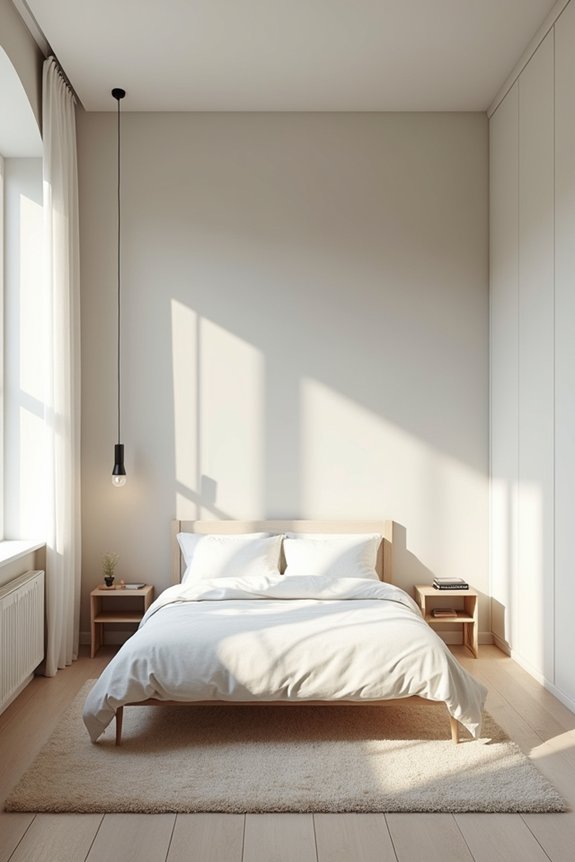
Then I discovered something simple: a unified palette actually works. I ditched the rainbow for whites, creams, beiges, and pale lilac accents. Suddenly, my cramped space felt more open.
Here’s what changed everything—light walls and ceiling maximize openness. I repeated the same color family across bedding, curtains, and furniture, creating cohesion instead of clutter. My pale-toned window treatments reflect natural light, eliminating that heavy, suffocating feeling I’d created before.
A designer friend validated what I’d learned: neutral bases with layered textiles introduce calm color without visual overwhelm. My small bedroom finally felt purposeful, not chaotic.
Use Multifunctional Furniture to Maximize Space
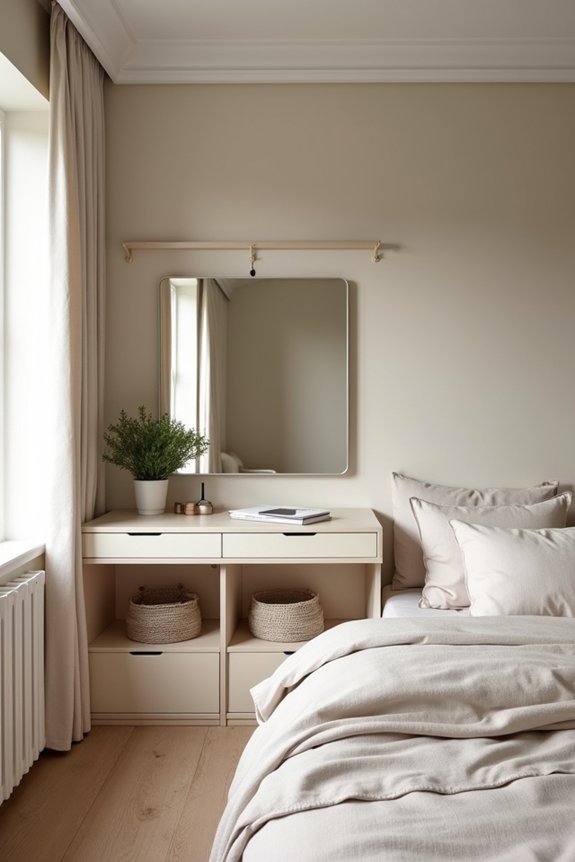
I learned the hard way that a bed without drawers underneath is basically just a fancy dust bunny farm—so I finally invested in a storage bed, and suddenly I’m not tripping over clean laundry at 2 a.m. My nightstand, which I upgraded to one with a pull-out shelf and built-in desk space, now holds my phone, a lamp, my half-drunk coffee from yesterday, and somehow still manages to look organized rather than like a Chuck E. Cheese gift shop exploded. Interior designer Sarah Barnard validates what my overtaxed closet already knew: “Multifunctional pieces aren’t luxuries in small spaces—they’re survival,” and honestly, that rings true when you’ve previously stored sweaters in a laundry basket under your bed.
Storage Beds And Drawers
Storage beds are basically the Swiss Army knives of small bedroom furniture—you know, those miraculous tools that somehow do seventeen things when you only need three, except these actually deliver on the promise. I’ve stuffed mine with everything from winter coats to that embarrassing Chuck E. Cheese cup collection, and nobody knows. A storage bed with built-in drawers turns wasted under-bed real estate into legitimate organizational gold. Pair yours with a slim dresser, and you’ve created a teammate who actually has your back. The key? Pushing these pieces against walls keeps your center open—suddenly your room has breathing room. Your essentials stay hidden but accessible. You’re no longer that person whose bedroom looks like a thrift store exploded.
Nightstands With Hidden Functionality
Why do nightstands become the graveyard of everything you don’t want guests to see? I’ve learned that nightstands with hidden functionality keep your bedroom organized instead of cluttered. Instead of displaying yesterday’s water glass and a mysterious Chuck E. Cheese cup, you can achieve intentional storage.
Consider these options:
- Built-in drawers that swallow lip balm, hair ties, and lotions—keeping surfaces pristine
- Pull-out shelves for devices and notes without cramping your already tiny floor space
- Round baskets on lower shelves that corral chaos while maintaining accessibility
- Slim profiles that preserve sightlines and breathing room
A compact workspace tucked into your nightstand means you’re not sacrificing style or functionality. You’re joining the people who actually have clear bedside surfaces—and honestly, that’s the community I want joining.
Choose a Bed With Smart Storage Solutions
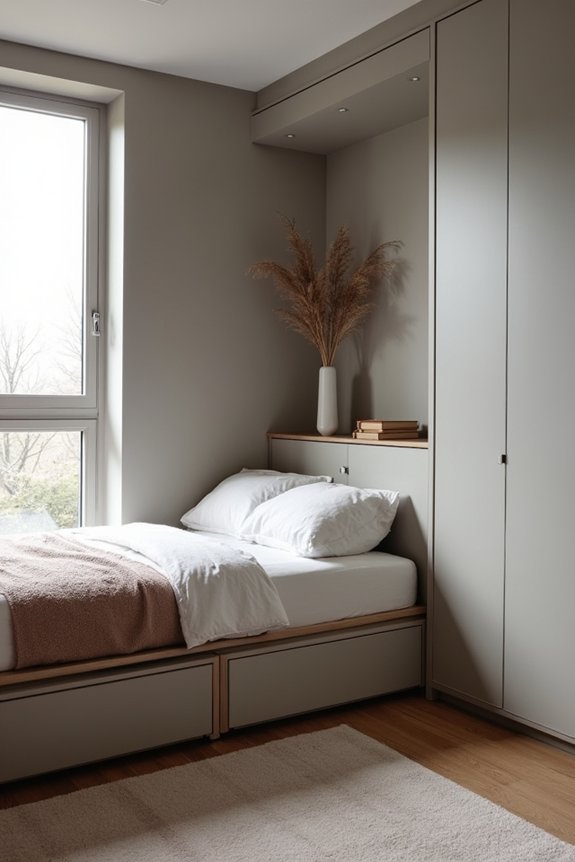
Your bed’s doing a lot of strenuous work in a small bedroom—literally and figuratively—so you might as well make it work twice as hard. I learned this the hard way, drowning in sweaters I’d shoved under my frame like some kind of textile hoarder. A storage-integrated bed solved the problem. Queen beds with built-in drawers hide seasonal clothes and linens without eating floor space. Pull-out shelves tucked into headboards keep nighttime essentials—glasses, books, that questionable midnight snack—within arm’s reach, eliminating the nightstand clutter spiral. Low-profile frames maintain breathing room while letting taller dressers remain visible. Designer tip: multifunctional pieces with hidden compartments minimize what’s visible. Your bedroom isn’t a storage unit; it’s a sanctuary. Smart bed selection makes that possible.
Select a Compact Dresser and Nightstand With Drawers
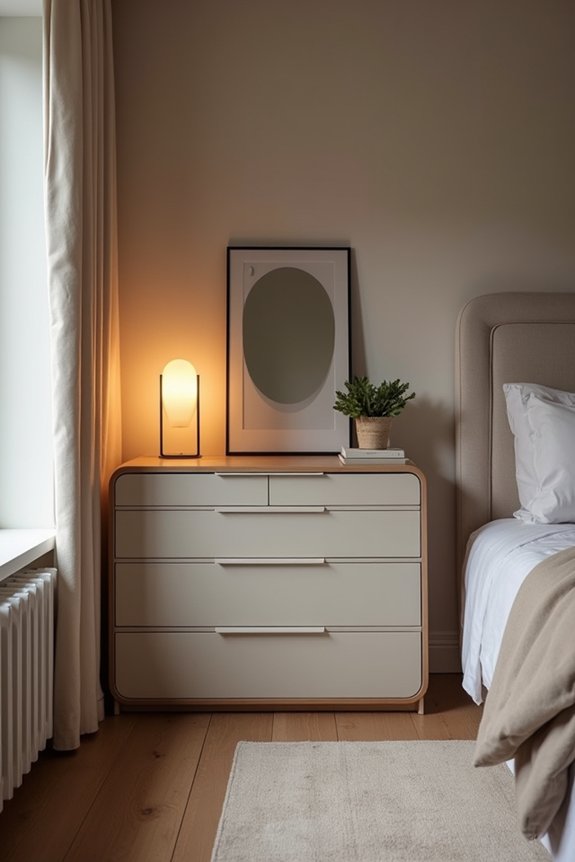
How many of us have stood in front of a nightstand so wide it practically requires a GPS to navigate around, only to realize we’ve created a bedroom obstacle course?
I’ve been there—surrounded by stacks of books, forgotten coffee mugs, and that mystery item from 2019. That’s when I discovered the value of a compact dresser and nightstand with multiple drawers. These workhorses hide clutter without consuming floor space.
What makes them practical:
- Hidden storage keeps daily chaos—socks, receipts, hair ties—completely concealed
- Low-profile silhouettes maintain walkways around your bed and breathing room
- Pull-out shelves function as vanities when needed
- Coordinated hardware creates visual consistency throughout your bedroom
As designers say, “storage that’s invisible is storage that works.” Now I understand why.
Position Furniture to Create Open Floor Space
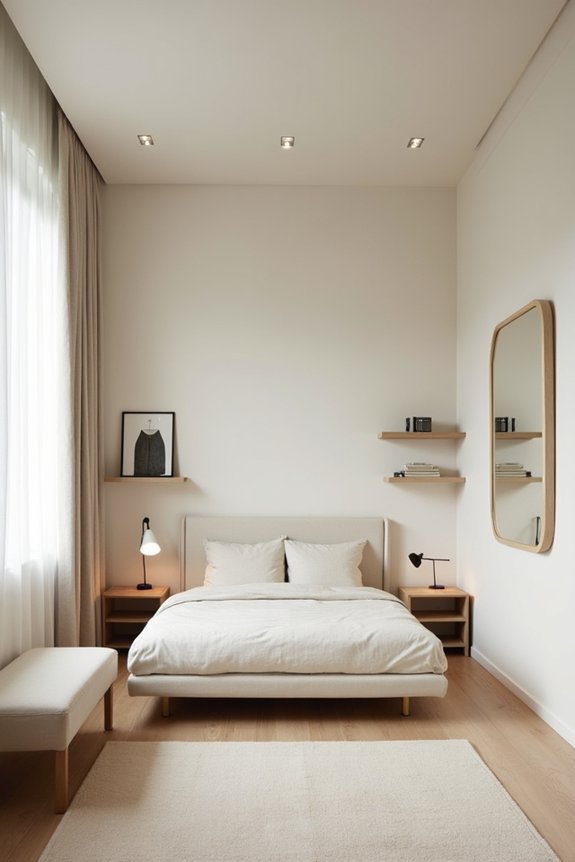
I learned the hard way that shoving my queen bed smack in the center of my 10×12 room—you know, for “balance”—was basically asking to stub my toes on furniture corners every morning, which my mom called “character building” while simultaneously complaining I had no floor space. Strategic bed placement, especially pushing that frame against the widest wall and away from windows, actually does create walkable pathways that don’t require sideways shuffling, and as one designer put it, “the bed is your anchor, not your obstacle course.” Low-profile furniture and multifunctional pieces—think beds with drawers or nightstands that don’t tower like furniture from a furniture store’s “aggressive maximalism” section—keep sightlines open and your room from feeling like a Chuck E. Cheese storage facility.
Strategic Bed Placement Matters
Where does your bed actually belong in a cramped bedroom? I’d stuffed mine in the corner like a forgotten Chuck E. Cheese prize, wondering why I felt claustrophobic. Strategic bed placement matters—it’s the difference between a livable bedroom and a shoebox you’re trapped in.
Push your bed against the widest wall, creating breathing room you’ll actually use:
- Open floor space that doesn’t mock your morning stumble
- Clear pathways preventing shin-bruising midnight navigation
- Reduced visual clutter making the room feel larger
- Better airflow away from radiators cooking your bedding
Position nightstands on the same wall, eliminating cross-traffic through your room’s core. Low-profile frames with storage drawers? They work well. They’re invisible space-savers—like having a helpful ninja under your bed instead of just dust bunnies plotting against you.
Maximize Walkable Floor Space
Now that your bed has actual breathing room instead of suffocating in a corner, you’ve got to protect that hard-won floor space—because furniture accumulates when you’re not looking. I learned this the hard way after stuffing a dresser, nightstand, and chair into my shoebox bedroom, then wondering why I couldn’t walk without doing an awkward shuffle.
Here’s the thing: your small bedroom’s livability depends entirely on movement. Choose low-profile pieces that don’t visually consume space. Mount shelves vertically. Use nightstands with drawers instead of adding separate storage units. Place your widest furniture—that dresser or desk—against the longest wall, leaving pathways clear for actual living.
Designer Sarah Barnard says it best: “Negative space isn’t empty; it’s deliberate.” That uncluttered floor? That’s your practical advantage.
Low-Profile Furniture Maintains Height
What’s the difference between a bedroom that breathes and one that suffocates you every time you open the door? Low-profile furniture. I learned this the hard way after cramming a massive sleigh bed into my 10×12 space—like trying to fit a cruise ship into a bathtub.
Here’s what actually works:
- Slim headboards that whisper instead of shout
- Shallow dressers that don’t eat your floor
- Beds hugging walls like they’re supposed to
- Nightstands that don’t require a GPS to navigate around
Design expert Marie Kondo notes that “height creates perception.” A low-profile bed with a streamlined nightstand instantly opens sightlines. Your ceiling feels higher. The room feels larger. No more Chuck E. Cheese vibes—just actual breathing room where you belong.
Refresh Bedding and Pillows Without Clutter
How’s your current bedding situation—honest assessment time?
How’s your current bedding situation—honest assessment time? Because your bed should whisper intention, not scream chaos.
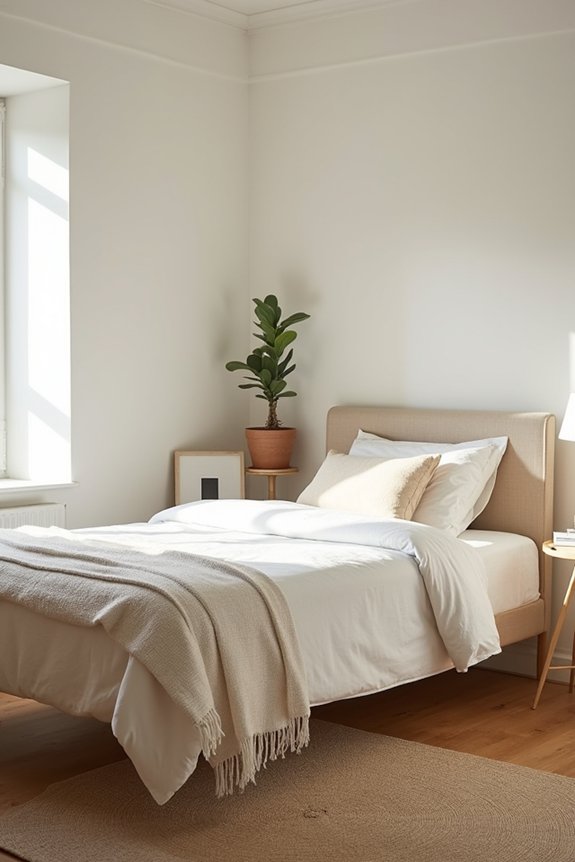
I used to pile my bed like I was auditioning for a hoarder documentary—mismatched shams, throw pillows that’d seen better days, the occasional Chuck E. Cheese cup hiding underneath. Then I switched to a neutral white comforter as my base layer, added one patterned duvet, and suddenly my bed looked intentional instead of chaotic.
Matching shams did the heavy lifting. They’re designer-approved shortcuts that whisper “I have my life together” without requiring actual effort. I layer decorative throw pillows strategically—buffalo check with solids, different textures talking to each other—using a cohesive color palette so nothing screams for attention like a toddler covered in ketchup.
The trick? Selective pillow increases for seasonal swaps. You’re not drowning in excess; you’re building calm through careful choices.
Use Tall Curtains to Open Up a Small Bedroom
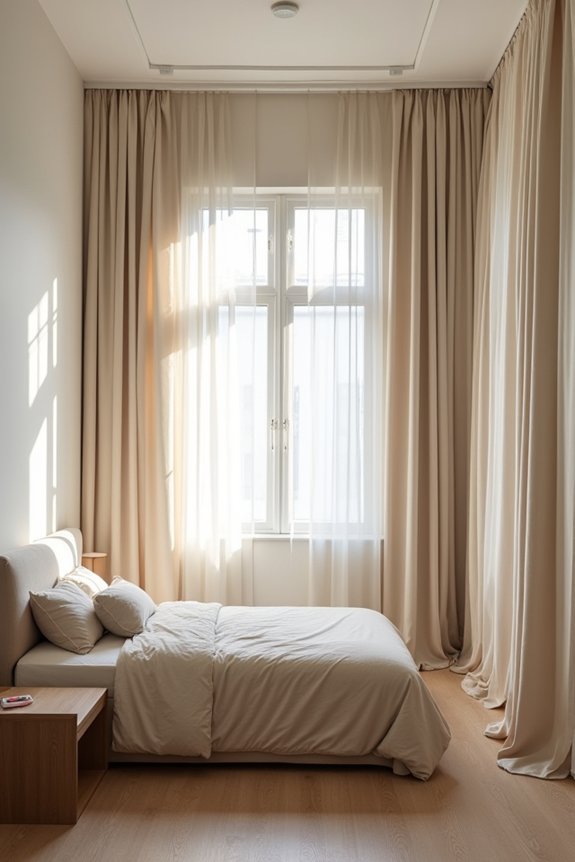
Your bed’s looking sharp now, but here’s what I learned the hard way: a perfectly styled mattress means nothing if your walls feel like they’re closing in.
Tall curtains—hung near the ceiling and dropping to the floor—trick your eyes into believing your room’s actually spacious. I’m talking multiple panels per side that create fullness and draw the gaze upward. Light-filtering sheers paired with solid neutrals (creams, beiges, whites) balance privacy while bouncing natural light everywhere.
Here’s what works in a cramped bedroom:
- Vertical lines that make you feel less claustrophobic
- Natural light dancing across surfaces instead of stagnant shadows
- A polished, intentional appearance that shows you’ve paid attention to detail
- Budget-conscious solutions by repurposing existing curtains from other rooms
Your small space doesn’t need imprisonment—it needs vision.
Use Mirrors to Make Your Room Feel Bigger
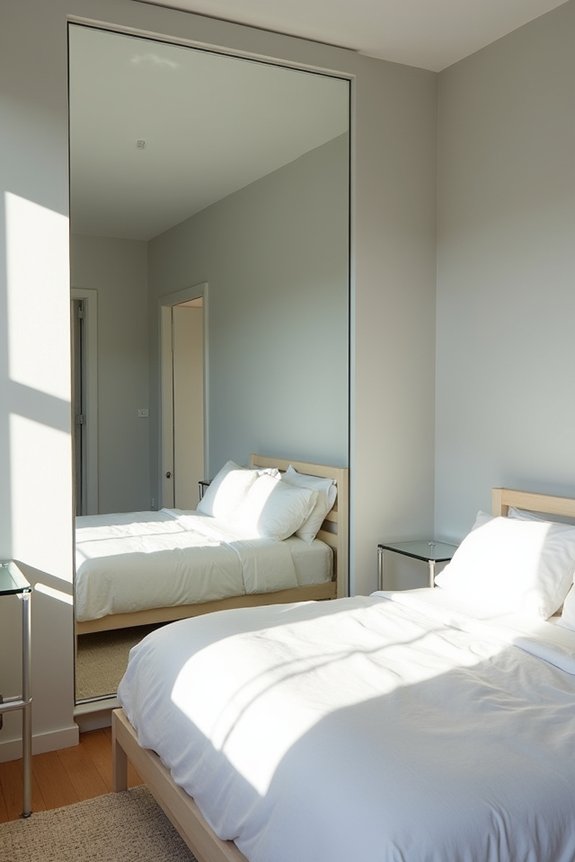
There’s something almost magical—and slightly delusional—about how a mirror can convince your brain that you’ve got twice the square footage you actually do. I learned this the hard way after my mom insisted I’d “ruin the walls” with tape, then complained my room felt cramped. Whatever.
Strategic mirror placement opposite windows bounces natural light around like a tiny sun trapped in glass. I mounted a full-length mirror flush against one wall—no jutting-out frames to stub your toe on—and suddenly my closet doesn’t look like a Chuck E. Cheese storage unit anymore.
Pair mirrors with light-colored surroundings and minimal clutter so you’re not just doubling the reflection of yesterday’s laundry pile. Consider mirrored furniture too. A nightstand with a mirrored surface amplifies brightness without looking like you’re compensating for a shoebox bedroom.
Use Nightstand Drawers and Baskets for Hidden Storage
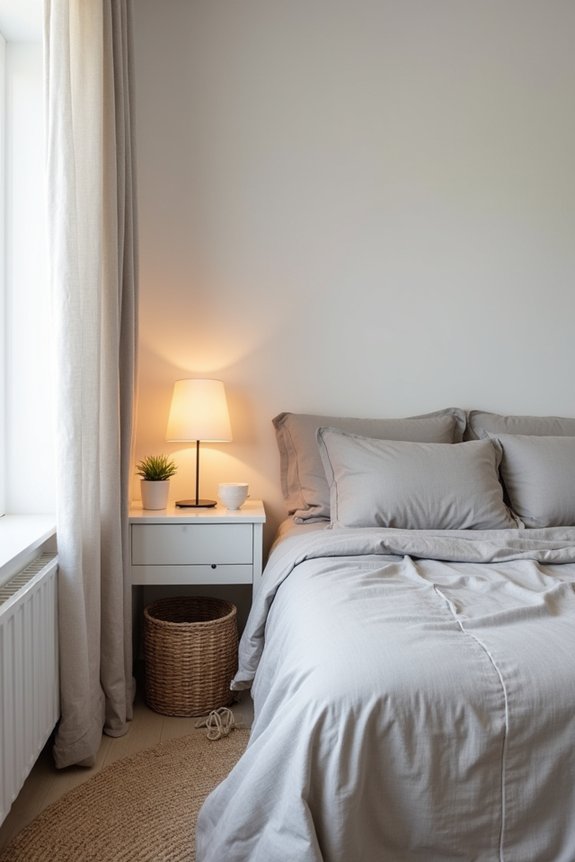
I learned the hard way that my nightstand—previously a graveyard of hair ties, phone chargers, and inexplicably three half-empty lip balms—needed an intervention, so I invested in drawers and baskets that actually hide the chaos instead of broadcasting it like some sort of bedroom crime scene. Now when I pull open those built-in drawers or tuck miscellaneous stuff into round baskets, I’m organizing and creating what designers call “visual calm,” which is fancy talk for “my mom won’t gasp when she visits.” Here’s what I discovered works: matching your storage containers to a neutral palette turns those hidden compartments from desperate band-aids into thoughtful design choices—suddenly my clutter’s got a *vibe*.
Drawer Organization Systems
When nightstand drawers become black holes where lip balm goes to die, it’s time to get strategic about hidden storage. I’ve learned that drawer organization systems aren’t just practical—they’re worthwhile. A dresser with multiple shallow drawers lets me separate socks from accessories without that chaotic mixed pile I used to dig through at midnight.
I’m drawn to removable plastic-covered shelves that maximize vertical stacking, accommodating seasonal rotations smoothly. Here’s what actually works:
- Discovering your favorite lotion exactly when you need it
- Knowing where every hair tie lives (finally!)
- Accessing undergarments without toppling towers
- Rotating seasonal items without bedroom drama
Pairing drawer organization with minimalist visible décor reserves surface space for essentials only. Designer Peter Marino notes that “organization isn’t decoration—it’s freedom.” I couldn’t agree more. Strategic hidden storage turns small bedrooms from cluttered disasters into spaces where everything’s exactly where it belongs.
Basket Storage Solutions
How’d you like to reclaim your nightstand from becoming a graveyard of charging cables, half-read books, and that chapstick you swear you bought yesterday?
I discovered basket storage solutions—they’re basically permission slips for chaos. Round baskets on lower shelves hide daily essentials while keeping everything within arm’s reach. You know, that practical place where your phone charger, lip balm, and three mystery hair ties live harmoniously instead of sprawling across your surface like some kind of bedroom crime scene.
What makes basket storage work? It maintains quick access without the visual overwhelm. I toss items inside, close my eyes, and suddenly my nightstand doesn’t scream “I’ve abandoned all hope.” These woven containers blend function with aesthetic—they’re the introvert’s solution to having friends over without explaining why everything’s visible.
Nightstand Styling Strategies
Your nightstand’s surface is basically real estate—and right now, you’re probably squatting on it like you’ve got no other choice. I get it. Mine looked like a convenience store exploded: three half-empty water glasses, that mystery chapstick, and approximately seventeen hair ties. Here’s the thing—nightstands with built-in drawers aren’t just furniture; they’re your permission slip to sanity.
Stash your daily essentials inside:
- Lip balms and lotions (the stuff you actually use)
- Hair ties and small accessories (no more scattered chaos)
- Phone chargers and cables (goodbye tangled disasters)
- Notepads and pens (for those 3 a.m. thoughts)
Add round storage baskets on lower shelves to corral smaller items. Keep your surface minimal: just a lamp, one small tray, and maybe a plant. Your bedroom doesn’t need to scream organization—it just needs to demonstrate it quietly.
Choose Bedroom Art That Doesn’t Clutter Walls
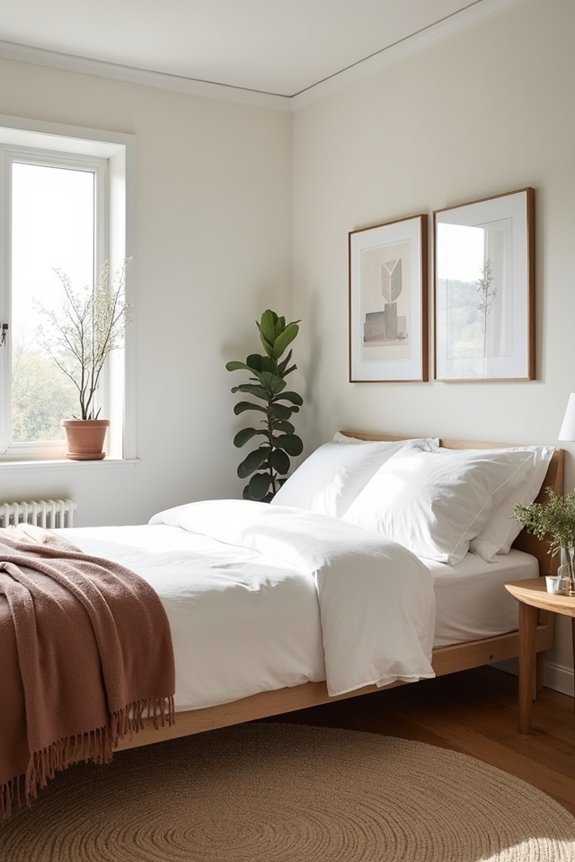
Why does every wall in a small bedroom somehow feel like it’s screaming for attention the moment you hang a single frame? I’ve learned that art selection makes or breaks the space. Instead of plastering walls like a college dorm—think ketchup-stained posters—I choose one oversized piece or a tight, purposeful grouping hung higher than eye level. This creates focus without visual chaos. I mirror my bedding’s color palette, keeping neutrals dominant with a single accent hue, which avoids looking random. Functional art works too: framed photos echoing room textures like linen or wood reinforce coherence. The trick? Leave breathing room. Negative space around art prevents that claustrophobic feeling where walls press inward. Restraint in decorating yields better results than abundance.
Add Plants to Small Bedrooms for Softness
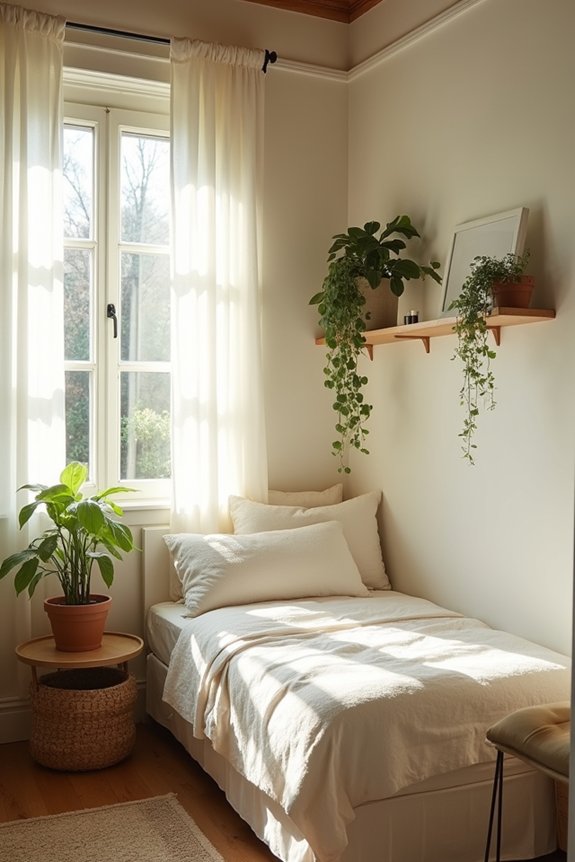
After committing to wall restraint—which felt like actual torture when I wanted to plaster my entire bedroom with motivational quotes—I realized I’d created this blank canvas that screamed “hospital room” rather than a comfortable retreat. That’s when plants entered the chat.
I discovered that low-maintenance varieties like pothos and snake plants work well in spaces without requiring my nonexistent green thumb. They thrive in indirect light, require minimal watering, and—here’s what matters—they actually make you *feel* like you belong somewhere worth caring for.
Here’s what plants deliver:
- Visual softness that whispers rather than shouts
- Natural focal points without eating floor space
- Proof you’re adulting (even if you’re not)
- A living, breathing room that hospitals can’t replicate
Strategically placed on windowsills and shelves, one statement plant paired with small terrariums creates intentional interest. Pruning occasionally prevents that “jungle abandoned by civilization” vibe. Plants don’t just decorate—they invite you home.
Use Window Treatments to Control Light in Small Bedrooms
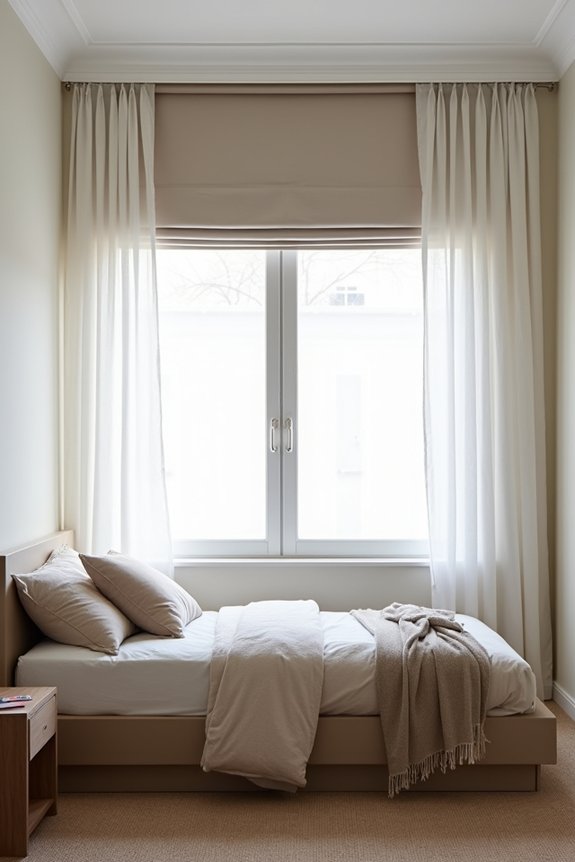
How many times have I woken up at 5 a.m. to sunlight aggressive enough to feel personal? Too many. That’s when I realized my window treatments weren’t just aesthetic—they’re practical necessities for small bedrooms. I’ve started layering light-filtering sheers with blackout panels, which sounds fancy but basically means I’m not squinting at ceiling stains anymore. Hanging curtains closer to the ceiling and letting them kiss the floor tricks your eye into believing the room’s actually spacious. Multiple panels per side? Yeah, that’s the move—it shows intentional thinking even when Chuck E. Cheese tokens hide behind my nightstand. Motorized blinds feel indulgent, sure, but adjustable light control in tight quarters? That’s smart design without the premium price tag.
Decorate Your Small Bedroom With Warm Neutrals
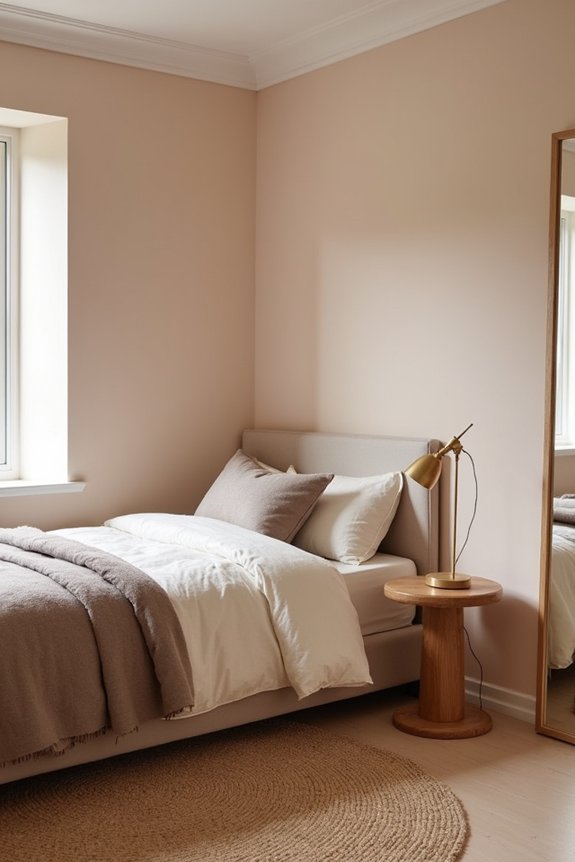
Once I stopped fighting my bedroom’s claustrophobic tendencies and embraced warm neutrals—creams, soft beiges, pale whites—everything shifted. I’d spent years cramming bold colors into corners, convinced I needed visual excitement. Wrong. My designer friend calls this approach “strategic emptiness,” and she’s onto something.
Neutral colors aren’t boring—they’re permission slips. They expand space, calm your nervous system, and hide the inevitable ketchup stains life throws at you. Here’s what actually works:
- Layering a pale comforter with taupe or soft lilac accents adds depth without chaos
- Mercury glass lamps introduce warmth without screaming for attention
- A single tall mirror bounces light around like you’re living in a respectable apartment
- Natural elements—one plant, some flowers—remind you that life exists beyond your four walls
This restraint? It works.