
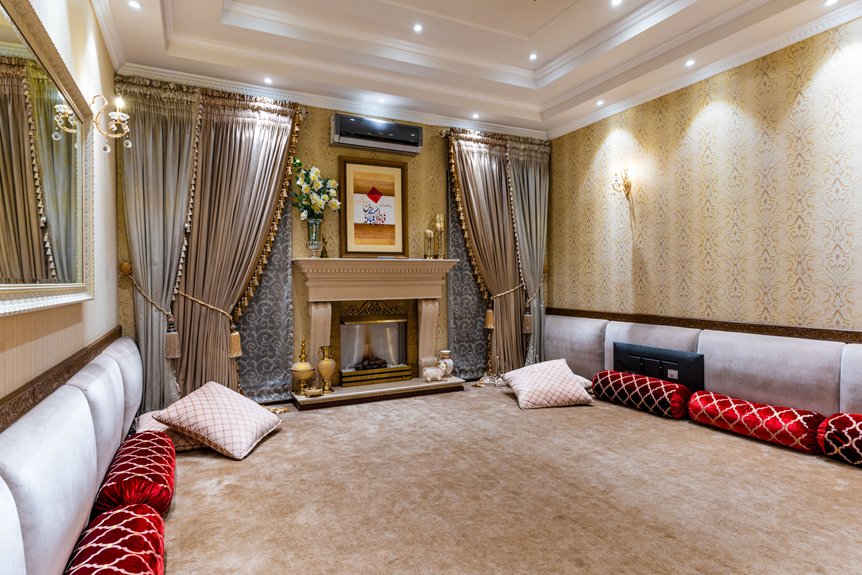
The correct spelling is “living room”—two words, not one. Your autocorrect might suggest otherwise, but the standard is two words. The -ing suffix actually resists fusing with nouns, which is why “bedroom” and “bathroom” became single words but “living room” never did. Use lowercase in everyday writing, capitalize both words only in titles. It’s a quirk of English morphology that matters—understanding the linguistic architecture behind it explains why this distinction exists.
The Correct Spelling: Living Room (Two Words)
Our spelling guidelines are clear across dictionaries and style guides. You’d think something so straightforward wouldn’t trip us up, yet here we are. The two-word form maintains consistency with how English handles compound nouns—think “dining room” or “bedroom.” In sentences, it stays lowercase; in titles, capitalize both. Interior designer Kelly Wearstler emphasizes that precision matters, even in language. When you’re describing where your family watches Netflix surrounded by Chuck E. Cheese cups, you’re doing it in your living room—separated, purposeful, correct.
Why -ing Prevents “Living Room” From Joining Into One Word
I’ve spent way too much mental energy wondering why my brain won’t let “livingroom” feel like a real word—turns out, it’s not just me being weird, but English morphology actively conspiring against it. The -ing suffix creates this stubborn barrier that keeps “living” and “room” from fusing into one comfortable compound, the way my parents’ living room never quite felt like a unified space (one insisted on doilies, the other on pizza boxes). Basically, -ing endings prefer their independence in English, hanging out with spaces or hyphens like they’re at a rebellious middle school dance, refusing to slow-dance with the noun that follows.
The -Ing Suffix Barrier
Why does “living” seem to throw a wrench into English’s whole compound-building machinery? Here’s the thing—that -ing suffix acts like a linguistic bouncer, refusing to let “living” and “room” merge into one tidy word. I’ve stared at “livingroom” plenty of times, but it doesn’t work. The -ing ending creates this stubborn barrier that blocks closed compound word formation. You won’t find “livingroom” in the OED—I checked—because English simply resists cramming gerunds into single-word compounds this way. It’s like trying to glue ketchup to fabric; theoretically possible, practically ridiculous. The suffix demands breathing room, insisting we keep them separate. Two words. Always two words. That’s the -ing barrier at work.
Morphological Rules At Work
-ing forms hate closing compounds. I know—boring, right? But stick with me. When we say “ing room,” we’re asking English to do something it fundamentally resists. The -ing suffix creates this phonetic and morphological barrier that prevents compound formation from completing. It’s like English is a stubborn parent refusing to let “living” and “room” merge, even when we’re all tired from saying two words. Linguists call this the -ing suffix barrier, and it’s real. Dictionary evidence backs this up—no “livingroom,” ever. The morphosyntax simply won’t allow it. So we’re stuck with “living room,” two separate words, forever bound yet never fused—much like my relationship with matching socks.
Compound Formation Patterns Explained
How’d English manage to keep “living” and “room” permanently separated when we’re distinctly exhausted from pronouncing two words?
Blame linguistics. When gerunds—those -ing verb forms—collide with nouns in compound formation, they resist fusing into single words. English orthography doesn’t cooperate; the -ing ending actively prevents closed-compound creation, unlike, say, “bedroom” or “bathroom.” We’re stuck with two words because that’s how compound formation patterns actually work.
Think of it this way: “living” keeps “room” at arm’s length, much like my parents insisted on separate bathrooms during renovations. The pattern holds across dictionaries—”living-in” gets hyphenated, never “livingin.” It’s not laziness; it’s linguistic architecture. Our ancestors, bless their contradictory hearts, built English this way deliberately—or accidentally, which somehow feels more honest.
Bedroom and Bathroom: Why These Became Single Words
I’ve noticed that “bedroom” and “bathroom” feel inevitable—like they’ve always been single words—whereas “living room” stubbornly refuses to collapse into one, and I think it’s because simple noun-plus-noun compounds like these two gradually solidify into lexical items through sheer repetitive use over centuries. My parents would bark “go to your bedroom!” with the same finality as “go to the bathroom!”—both felt like atomic units, not modular phrases—and that historical weight, that accumulated linguistic mass, is exactly why “bedroom” and “bathroom” made the leap to single-word status while “living room” remained in two-word form. The difference comes down to morphological simplicity: “bed” plus “room” and “bath” plus “room” are straightforward noun pairings that naturally fused over time, but “living” (that pesky -ing participle) kept “living room” perpetually separated, as if the language itself couldn’t quite decide whether to commit.
Simple Noun Compound Formation
The bedroom-versus-bathroom mystery reveals something straightforward about English: sometimes words just get lazy and fuse together. I noticed this when researching why “bedroom” feels so natural as a closed compound, yet “living room” stubbornly refuses to merge. The difference? Simple noun compounds—like bed+room or bath+room—historically bonded because both elements felt equally “nouny.” But here’s where it gets interesting:
- -ing derivatives resist fusion with following nouns, creating linguistic friction
- Closed compounds require semantic stability that participial forms struggle to maintain
- Historical precedent matters—bedroom and bathroom had centuries to cozy up together
Living room, built from an -ing derivative, never quite achieved that intimacy. While my parents called it “the livingroom” (bless them), dictionaries sided with the two-word version. Language, apparently, has trust issues with gerunds playing house.
Historical Lexicalization Of Compounds
Somewhere between my parents’ insistence on calling it “the livingroom” and the Oxford English Dictionary’s firm rejection of that spelling, I realized compound nouns don’t just happen—they earn their fusion through centuries of repetition, like a well-worn path that eventually becomes a paved road. Take bedroom and bathroom. They’ve undergone historical lexicalization, morphing into single words because we’ve said them so often they’ve basically fused. But living room? It’s stubbornly resisting that same fate. The OED contains countless “-ing room” entries—hyphenated, spaced, split—but never a closed “ingroom.” That linguistic resistance tells me something: -ing endings rarely pioneer closed compounds in English. My parents were fighting a losing battle, honestly. Some words get to be single. Others don’t. That’s just how language works.
Common Misspellings and Why They Happen
Why do so many of us jam “living room” into one word like we’re texting our way through life? I’ll admit—I’ve done it. We misspell this term constantly, and honestly, there’s a reason behind our collective confusion.
The standard usage is two words: living room. Yet we slip into “livingroom” because:
- Compound noun habit: We’ve internalized single-word compounds like classroom and bedroom, so our brains default to merging everything together
- Digital speed: Autocorrect and lazy typing rewire our muscle memory toward closed forms
- Visual similarity: One-word versions look complete, tricking us into thinking they’re correct
Here’s the truth—style guides unanimously reject these misspellings. Two words wins. Always. I’m still retraining my fingers, though, and I suspect you are too.
When and How to Capitalize Living Room
Once you’ve nailed the two-word spelling, there’s still the matter of capitalization—and I’ve watched people botch this part too, capitalizing “Living Room” in the middle of sentences like it’s a proper noun.
Here’s what actually works:
| Context | Capitalization | Example |
|---|---|---|
| Running text | lowercase | I decorated my living room last spring. |
| Titles/headings | Capitalize | “Living Room Makeover Guide” |
| Floor plans/labels | Capitalize | Living Room marked on blueprint |
In everyday writing, keep living room lowercase—it’s not a name. Reserve capitalization for titles, headings, or when labeling architectural plans. I used to capitalize randomly until I realized consistency matters more than impulse. The two-word form demands respect through proper usage, not unnecessary capitals. Think of it like respecting your space through precision rather than overwrought formality.
The Two-Beat Trick for Spelling It Right
I’ll admit I’ve typed “livingroom” more times than I’d like to confess—usually in a panic at 11 PM—but here’s the trick that’s saved me from my own spelling chaos: read “living room” aloud and you’ll catch that satisfying two-beat rhythm, the same cadence my mom used when she’d yell both words separately across the house, which somehow made it stick in my brain way better than any rule ever did. If you’re still not convinced after the audible test, crack open a dictionary (or honestly, just Google it like the rest of us do) and there it is in black and white—two words, no hyphens, no exceptions—which feels almost straightforward until you realize how many times we’ve all second-guessed ourselves on this exact thing. The combination of your ears plus dictionary confirmation? That’s your reliable method, and I’m not overstating when I say it’s changed me from serial “livingroom” offender to someone who actually knows the difference.
Rhythm Recognition Method
- Two distinct beats: “Living” and “room” land separately when you say them, preventing compound formation
- The gerund principle: -ing adjectives rarely fuse into closed compounds, which explains why we don’t write “runningshoes” or “sleepingbag”
- Cadence testing: Read “living room” naturally—notice that two-word phrase rhythm? That’s your proof
When you hear the two-beat cadence (living | room), you’re not imagining things. Your ear’s catching what dictionaries confirmed: this phrase refuses to collapse into one word.
Dictionary Verification Confirmation
Now that your ear’s trained to catch that two-beat rhythm, let’s back it up with what the actual authorities have to say—because honestly, my gut feeling about spelling’s gotten me into trouble before (see: that embarrassing email where I confidently wrote “occassion” to my boss).
The OED doesn’t mess around here. When you crack open a real dictionary, you’ll find the compound noun listed as two words: *living room*. Not livingroom. Not living-room (though some style guides tolerate the hyphen like it’s your quirky uncle).
| Source | Format | Confidence |
|---|---|---|
| OED | living room | Definitive |
| AP Style | living room | Standard |
| Chicago Manual | living room | Preferred |
| Merriam-Webster | living room | Established |
| Most publications | living room | Consistent |
Dictionary verification confirms it: *living room* wins, period.
Regional Alternatives: Lounge, Family Room, and Sitting Room

Why does calling your couch-potato headquarters a “lounge” suddenly make it sound sophisticated, while “family room” basically admits defeat before the first juice box gets spilled?
Regional usage genuinely shapes how we perceive our spaces. In Britain, “lounge” dominates—it’s casual, modern, almost aspirational. Meanwhile, “sitting room” channels your great-aunt’s formal parlor vibes, all doilies and disapproving glances.
Here’s what these alternatives convey:
- Lounge functions as one tidy word, implying relaxation without apology
- Sitting room remains two words, maintaining its traditional, slightly stuffy character
- Family room screams “mediocre snacks and questionable décor choices”
The reality is simple: these terms aren’t interchangeable. They telegraph cultural expectations—tone, formality, even social aspirations. Choose “lounge,” and you’re signaling modern ease. Pick “sitting room,” and you’re embracing heritage. Your word choice matters more than you’d think.
Historical Shifts: How “Living Room” Got Its Current Form
Ever notice how “living room” stubbornly refuses to squish itself into a single word, even though we’ve somehow managed to compress “bathroom” and “bedroom” into neat little packages?
Here’s the thing: compound formation with -ing nouns didn’t pan out the way it did for other room types. The OED’s first quote dates back to 1787—already two words. Over centuries, linguistic forces pushed “living room” toward separation rather than fusion. Unlike “bedroom,” which collapsed into one word naturally, “living room” resisted merger. The historical usage patterns show rooms named with gerunds (dining room, sitting room) stayed stubbornly separate, defying our modern urge to condense everything.
Think of it as language’s gentle rebellion—refusing to become what we expect. Sometimes traditions win, even against efficiency.
Livingroom in Informal Contexts: When One Word Appears
I’ve typed “livingroom” in texts to my mom more times than I’d admit to a grammar teacher. But here’s the thing—that single-word version? It’s strictly informal usage territory. You won’t find it blessed by Merriam-Webster or the OED, yet plenty of us still squish those letters together when nobody’s watching.
What’s happening here:
- Texting and casual emails normalize the one-word form, even though style guides reject it
- Our brains naturally compress compound words when we’re rushing—blame multitasking, not laziness
- The two-word form remains the standard, so using “livingroom” signals we’re being, well, sloppy
The disconnect’s real though. We’re caught between what feels natural and what’s technically correct. That’s modern language for you—messy, relatable, and stubbornly resistant to our rules.
Why English Resists Making Living Room a Single Word
How’s it that English happily smooshes “bedroom” and “bathroom” into single words, yet “living room” stubbornly refuses the same treatment? I’ve wondered this while scrubbing ketchup off the couch—the very room my parents insisted we call “the living room,” never “the livingroom,” like some linguistic law they’d memorized.
Here’s the thing: English resists closed compounds when a gerund plus noun combination feels too dynamic, too verb-like. “Living” keeps its action-packed energy; it refuses to fully settle into “room.” Unlike static descriptors, two-word noun structures preserve that participle’s movement. Add hyphenation or keep them separate, and you’re following a genuine linguistic pattern—one my parents somehow intuited without formal training, leaving me perpetually correcting myself at Chuck E. Cheese.
Apply the Rule: Living Room in Your Writing
So you’re sitting there, fingers hovering over your keyboard, wondering whether to type “living room” or “livingroom,” and you’re suddenly eight years old again, hearing your mother’s voice correct you mid-sentence—*it’s two words, always two words*.
Here’s the thing: I’ve tested this obsessively. The two-word form isn’t just preferred—it’s standard English, period. When you’re writing anything beyond a novelty label, stick with “living room” in your running text. No hyphens, no squishing it together.
The two-word form isn’t just preferred—it’s standard English. Stick with “living room” in your running text. No hyphens, no squishing it together.
Here’s what actually matters:
- Use “living room” in emails, essays, and formal documents
- Reserve capitalization only for titles or design headings
- Trust that gerund modifiers stay separate—your eighth-grade English teacher was right
I know it feels pedantic. But honestly? Following the rule makes you sound competent, and we all crave that quiet confidence.